A BJD faceup is the painted customization applied to a ball-jointed doll head. A beginner workflow usually moves from a clean, protected resin surface to light pastel color, watercolor-pencil or fine-brush linework, controlled sealing, and final details. You can learn this sequence without an airbrush. The goal of a first faceup is not perfection—it is learning a repeatable order that protects the doll and makes corrections manageable.
What counts as a BJD faceup?
A faceup includes the visual work that gives a blank doll head its expression: blushing, eyebrows, lashes, lip color, eyelid definition, shadows, highlights, and optional decorative details. The term is broader than ordinary makeup because the artist is also creating facial features and character cues on a sculpted resin surface.
Before starting, look at the sculpt in neutral light. Notice the brow ridge, eyelid depth, lip shape, nose planes, and areas where the sculpt naturally creates shadow. A design that follows those forms is easier to control than one that fights them.
BJD faceup, BJD doll face-up, and ball-jointed doll makeup
BJD faceup, BJD doll face-up, and ball-jointed doll makeup tutorial usually describe the same core subject: adding protected color and character detail to a ball-jointed doll head. Artists most often use the word faceup because the work includes more than cosmetic makeup. It can define brows, lashes, eyelids, lips, blush, shadows, highlights, freckles, and fantasy markings.
A general doll makeup tutorial may cover vinyl fashion dolls or other surfaces, so confirm that the instructions are specifically intended for the resin, sealant, and materials used in your BJD workflow. Surface compatibility matters more than the label attached to the tutorial.
A practical beginner sequence
- Choose a simple reference and limit the first palette to a few coordinated colors.
- Prepare a clean, dust-controlled workspace and protect yourself according to every product label and safety data sheet.
- Clean and inspect the head without sanding or using strong chemicals unless the doll maker and product instructions support that process.
- Apply the compatible base sealant exactly as directed and allow it to cure fully.
- Build soft blush and shadow in light passes, checking symmetry in natural light.
- Add brows, lashes, lip lines, and other fine details with controlled marks.
- Seal completed stages only when the materials and surface are ready.
- Add compatible gloss or final accents after the protected color layers are complete.
Your first-faceup practice card
Keep one reference photo and record each stage under the same lighting. Work on one decision at a time: broad color placement first, then the weight and direction of small marks. The checkpoints below help you decide what to practice before deepening a layer.
| Stage | What to check | Practice before continuing |
|---|---|---|
| Plan | Can you describe the intended expression and choose a small palette? | Mark brow starts, peaks and ends on a reference drawing. |
| Soft color | Do the cheeks and eye areas still read as one expression from portrait distance? | Pick up less pigment on a separate practice surface and compare light passes. |
| Fine lines | Are the brow and lash strokes intentional rather than getting thicker with each correction? | Rehearse tapered strokes and mirrored curves away from the doll. |
| Before sealing | Have you photographed the result and checked the complete material system? | Make corrections only with a method tested for the current layer; follow the sealant instructions before continuing. |
What should a beginner practice first?
Practice dots, tapered lines, parallel strokes, and mirrored curves on a separate surface before working on the head. These drills translate directly into eyelashes, brows, lip creases, and small texture marks.
For color, practice picking up less pigment than you think you need. Subtle layers are easier to deepen than heavy color is to remove. Keep a short note of the tools, colors, drying time, and order used so the next attempt is more predictable.
How to do a BJD faceup without an airbrush
An airbrush is optional for a first BJD faceup. Dry chalk pastel applied with a soft dedicated brush can build blush and shadow, while a sharp compatible watercolor pencil or a fine pointed brush can create brows, lashes, lip lines, and small accents. The important skill is controlling light layers, not owning a particular machine.
Work from broad, pale color toward smaller and darker marks. Remove loose dust before the next compatible sealant stage, and never improvise spray conditions: the sealant label and safety data sheet determine ventilation, protective equipment, distance, temperature, humidity, and cure time.
- Use dry chalk pastel—not oil pastel—for soft blush and shadows.
- Use a tested watercolor pencil for sketching and tapered line details.
- Use selected water-based acrylic paint with a fine brush when an opaque accent is needed.
- Practice pigment pickup and line pressure on a separate surface before touching the head.
How long does a first faceup take?
The hands-on painting may fit into several focused sessions, but drying, curing, correction, and photography add time. Do not rush because a layer looks nearly dry. The product instructions—not a generic online timer—should decide when the next step is safe.
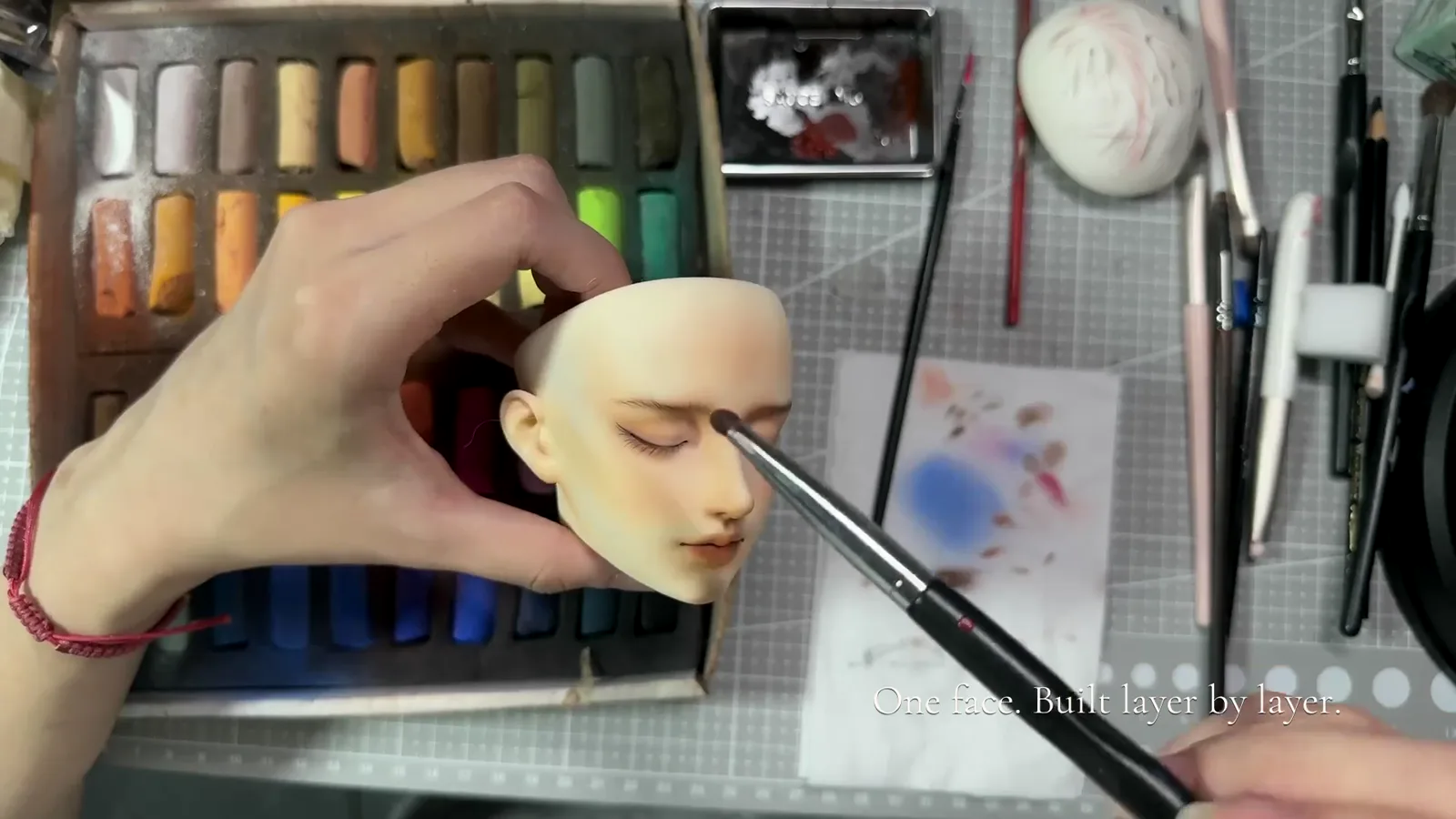
Read a faceup in progress: three visual checkpoints
These stills come from the academy’s existing public 46-second course preview. The timestamps locate moments in an edited clip, not working or drying times. The preview does not show every preparation, sealing or correction step.
00:03 — Look at the sculpt before adding detail
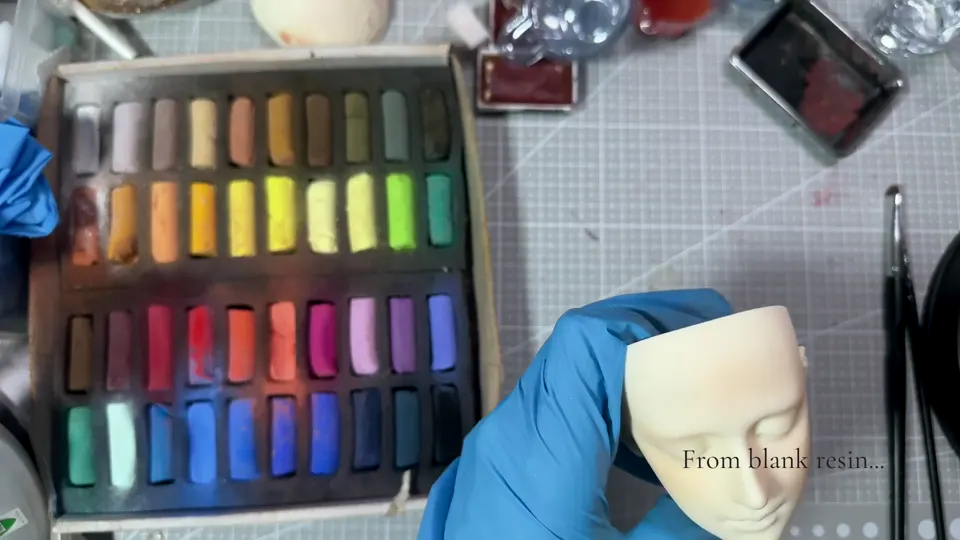
What is visible: The sculpted eyelids, nose and mouth are visible before the stronger painted details shown later in the preview.
Your practice checkpoint: On your own reference image, mark the brow starts, peaks and ends before painting. Keep a photograph of your starting point; do not assume that a pale-looking surface has already been prepared or sealed.
00:15 — Check broad color before fine lines
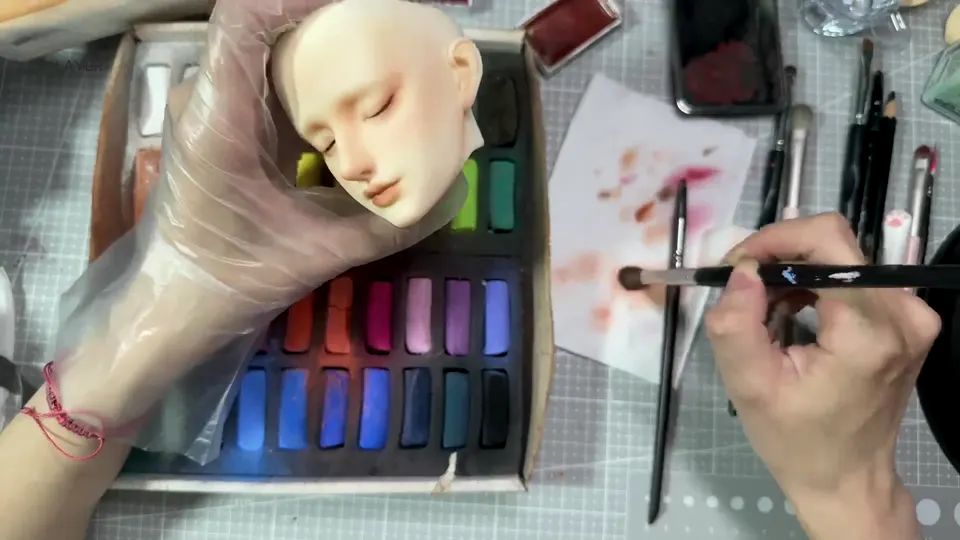
What is visible: Soft color is visible around the eyes and cheeks, with color on the lips. The nearby paper shows separate color marks.
Your practice checkpoint: Compare the overall expression from portrait distance under consistent lighting. Rehearse a light pass on a separate, compatible practice surface before deepening the color on your doll. A stronger mark is harder to judge while looking only at one small area.
00:33 — Compare the small marks with the whole face
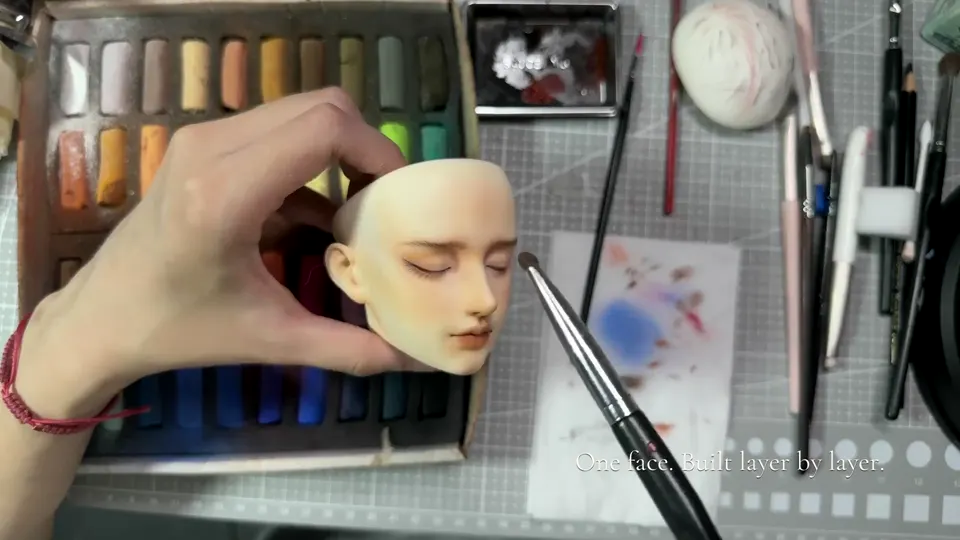
What is visible: Brows, lash lines and the lip contour are more defined in this later moment. They can now be compared with the softer surrounding color.
Your practice checkpoint: Photograph both sides at the same angle and compare line weight, direction and spacing. When a stroke needs practice, rehearse it away from the doll rather than repeatedly thickening the opposite side to match.
Use these views to practice observation, not to identify a product formula or verify a material’s compatibility. Follow the material-specific guidance and safety notes in this guide.
Watch the original public preview · How these examples are sourced
Frequently asked questions
Questions about bjd faceup tutorial for beginners
Can I do a BJD faceup with no painting experience?
Yes. Start with line-control exercises, a simple color plan, and a small number of compatible materials. A structured first project is easier than attempting advanced effects immediately.
Should I practice on my favorite head first?
A lower-stakes practice head or removable practice surface is preferable when available. If you use a valued head, keep the design simple and verify every material before application.
Do I need an airbrush for a BJD faceup?
No. A beginner can build soft color with compatible dry chalk pastel and create details with tested watercolor pencils or fine brushes. An airbrush is a later option for specific effects, not a requirement for learning the workflow.
Can I use watercolor pencils on a BJD faceup?
Watercolor pencils are commonly used for controlled lines, but the exact pencil, sealant, resin, and finishing layers must be tested together first. Do not assume every pencil binder is compatible with every surface system.
Is ball-jointed doll makeup the same as a BJD faceup?
Usually, yes. BJD faceup is the more precise community term because the work can include complete facial definition and character effects, not only cosmetic-style makeup.